
Many Australian homeowners think about developing their land at some point. Some picture subdividing a large block. Others plan a duplex, a knockdown rebuild, or a small renovation to sell. Along the way, common misconceptions about property development trip up otherwise careful owners.
Some assume the rules are the same in every state. Others assume approval alone means the numbers will work. This guide sets out what the relevant Australian authorities actually say, without predicting prices or pushing you toward any decision. At realCLEAR, we would rather give you the full picture than win a listing.
Common Misconceptions About Property Development in Australia
Below are fourteen misconceptions we hear often from homeowners. Each one is checked against the current rules from the relevant authority.
1. Profit From Development Is Always a Capital Gain
Many owners assume any profit from developing and selling land is a capital gain. They expect the 50 per cent capital gains tax (CGT) discount to apply automatically. The Australian Taxation Office often disagrees. Under Taxation Ruling TR 92/3, profits from isolated transactions can be treated as ordinary income.
This applies when land is bought, subdivided, or developed with a profit-making purpose. In that case, the profit is taxed at your marginal rate, and the CGT discount does not apply. Tribunal decisions have confirmed this can catch everyday homeowners, not just professional developers. This area is genuinely complex and fact-specific. Always get independent tax advice before you commit. Source: Australian Taxation Office, TR 92/3.
2. You Never Need a Licence If You Do the Work Yourself
Some owners believe doing the work themselves avoids licensing rules altogether. That is not correct in most states. Licensing thresholds and permits differ by state, so always check with your own state authority. We cover a specific state example later in this guide.
3. Every State Runs the Same Planning Approval Process
It is easy to assume development approval works the same way nationwide. It does not. Each state and territory runs its own planning system, with its own authority, forms, and pathways. A process that suits a project in one state may not apply at all elsewhere. This is one of the most common misconceptions about property development we hear from owners moving between states.
4. Every Development Needs a Full Council Application
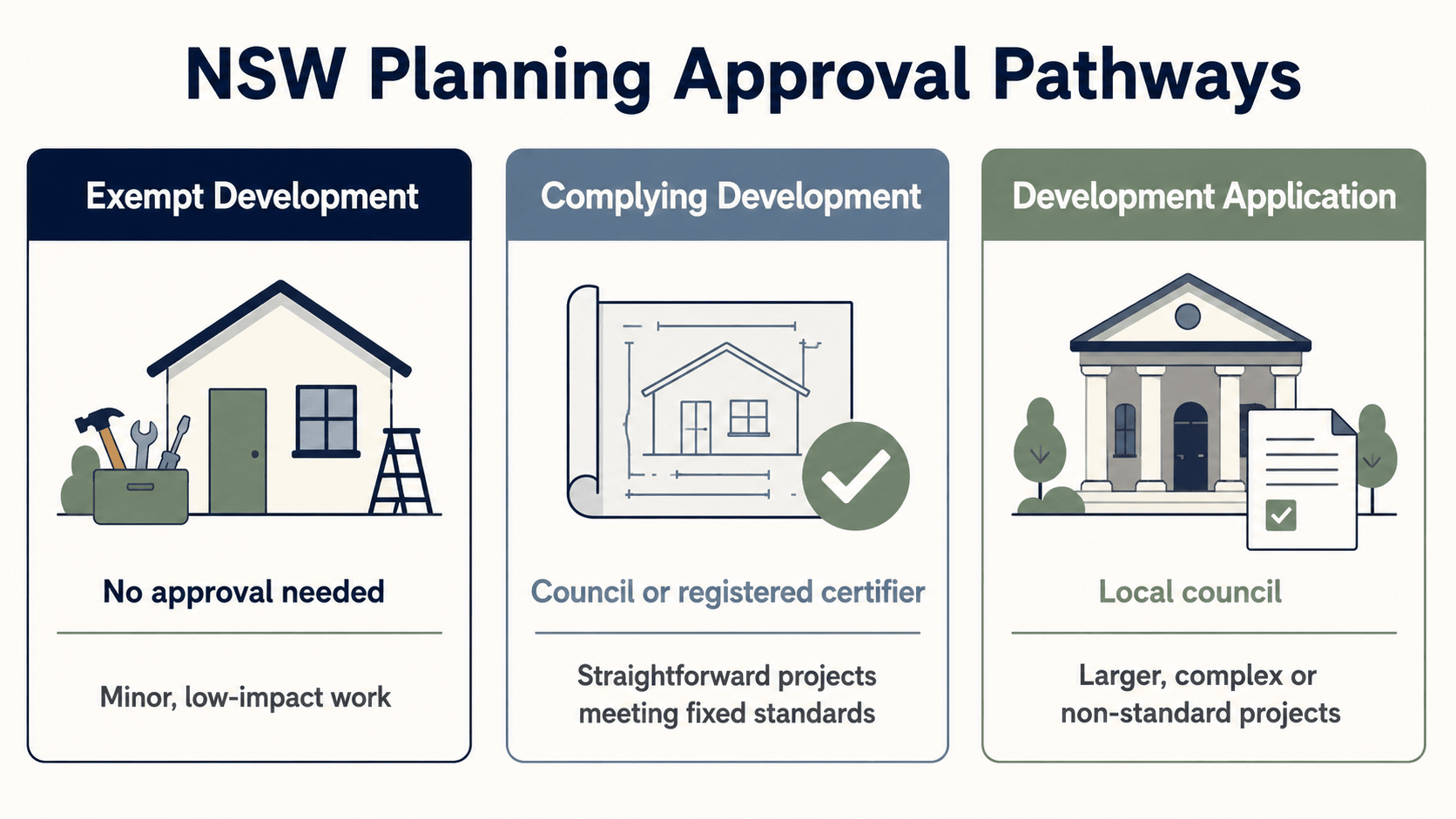
Many people assume every project needs a formal Development Application (DA), a council’s detailed assessment of a proposal. In New South Wales, some low-impact work is exempt development and needs no approval at all.
Other projects may qualify as complying development, a faster pathway assessed against fixed standards by council or a private certifier. Only larger or non-standard projects generally need a full DA. Source: NSW Department of Planning, Housing and Infrastructure.
5. Getting Approval Guarantees a Profitable Project
Development approval confirms a project meets planning and building rules. It says nothing about whether the finances will work. Construction costs, finance costs, and holding costs can all move during a project. realCLEAR does not predict future prices or returns, and neither should any approval certificate. Speak with a qualified professional before committing capital.
6. GST Never Applies to a Small, Personal Project
Some owners think GST only concerns large commercial builders. Selling your own established home is generally GST-free, but selling new residential premises is usually different. The Australian Taxation Office generally applies GST to the sale of new residential premises, including many small-scale developments.
Eligible sellers may reduce their GST liability using the margin scheme, calculated only on the profit margin, not the full price. Since 1 July 2018, buyers of new residential premises or potential residential land must generally withhold the GST component and pay it directly to the ATO at settlement. Source: Australian Taxation Office, building and construction: residential premises.
7. Land Tax Only Applies Once You Rent the Property Out

Land tax is assessed annually on land value, not on rental income. It can apply to land held during a development, including vacant land. Thresholds and rates differ significantly by state. In NSW, the general threshold was frozen at $1,075,000 from the 2025 land tax year. In Victoria, the general threshold is far lower, at $50,000. This gap shows why state-specific advice matters. Sources: Revenue NSW and State Revenue Office Victoria.
| State | General land tax threshold (2025-26) | Assessment date |
|---|---|---|
| New South Wales | $1,075,000 | 31 December |
| Victoria | $50,000 | 31 December |
This table is illustrative of the gap between two states. Rates, thresholds, and exemptions change and differ across all states and territories. Always confirm current figures with your own state revenue office.
8. The Cooling-Off Period Is the Same for Every Contract
Buyers sometimes assume they always get several days to reconsider a purchase. In NSW, most residential private treaty contracts carry a five business day cooling-off period after exchange, extended to ten business days for off-the-plan contracts. There is generally no cooling-off period for auction sales. Rules differ in other states, so this cannot be assumed to apply nationally. Source: NSW Government, contracts and deposits when buying property.
9. Approval Means You Can Start Building Straight Away
Getting development consent in NSW is only one step. In most cases, you also need a separate Construction Certificate before any building work begins, confirming your detailed plans meet the Building Code of Australia. A principal certifier must also be appointed to carry out inspections during the build. Skipping this step can make the certificate invalid later. Source: NSW Fair Trading, approvals for building and renovating.
10. Holding Land for 12 Months Guarantees the CGT Discount
Many owners believe that simply holding land for more than a year secures the 50 per cent CGT discount. Holding period is one factor, but the ATO also weighs the reason the land was bought and developed. Tribunal cases, including one involving a husband and wife with no development history, have found isolated profit-making transactions taxable as ordinary income, even after a long hold. Source: Sladen Legal, summary of McCarthy v Commissioner of Taxation.
11. Withholding Tax on Sale Only Affects Foreign Owners
This is a genuinely common misconception about property development and property sales generally. Foreign resident capital gains withholding applies to all Australian property sales, not only sales by foreign owners. Australian resident sellers must actively obtain a clearance certificate from the ATO and give it to the buyer at or before settlement. Without one, the buyer must withhold 15 per cent of the sale price and pay it to the ATO, even for a fully compliant Australian resident. Source: Australian Taxation Office, foreign resident capital gains withholding overview.
12. Only Big Companies Can Develop Property
Small-scale development, such as a duplex or a straightforward subdivision, is realistic for many homeowners. Fast-track planning pathways in some states exist partly for this reason. It still requires careful budgeting, the right approvals, and honest advice before you commit any capital.
13. Complying Development Means No Oversight During Construction
Some owners think a fast-track approval means fewer checks once building starts. In NSW, complying development still requires a principal certifier to carry out inspections during construction, similar to a Development Application pathway. Fast approval is not the same as no supervision.
14. Rising Prices Guarantee Any Development Will Pay Off
Some owners assume that because property values have risen before, any development will be profitable. realCLEAR never predicts future prices or market direction, and we would encourage caution around anyone who does. Holding costs such as land tax, financing, and GST can erode a margin regardless of the broader market. Once a project is finished, the decision to sell, rent, or hold is personal. realCLEAR’s Sell service, Rent service, and Manage service exist to support whichever path suits you, without pressure either way.
A State-Specific Example: Planning Approval Pathways in New South Wales
Rules on approvals, licensing, and land tax vary across Australia. As a concrete example, here is how planning approval works in New South Wales. This section describes NSW rules only. Other states and territories run comparable, but different, systems, so confirm current requirements with your own state authority before relying on anything here.
NSW offers several planning pathways, administered through the NSW Planning Portal. Exempt development covers minor, low-impact work and needs no formal approval. Complying development is a faster pathway, assessed by council or a registered certifier against fixed standards set out in state planning policy. A full Development Application is a merit-based, more detailed assessment by the local council, generally used for larger or non-standard projects. Source: NSW Department of Planning, Housing and Infrastructure.
| Pathway | Who assesses it | What it suits |
|---|---|---|
| Exempt development | No approval needed | Minor, low-impact work |
| Complying Development Certificate | Council or registered certifier | Straightforward projects meeting fixed standards |
| Development Application | Local council | Larger, complex, or non-standard projects |
Separately, licensing for construction work is also state-based. In Queensland, for example, an owner-builder permit from the Queensland Building and Construction Commission (QBCC) is generally required for residential work valued over $11,000 where the owner is managing the project. Only one owner-builder permit is issued per person every six years, and trade work such as electrical or plumbing still needs a separately licensed contractor. This is a Queensland-specific rule and does not apply in NSW or any other state. Source: Queensland Building and Construction Commission.
An Illustrative Scenario
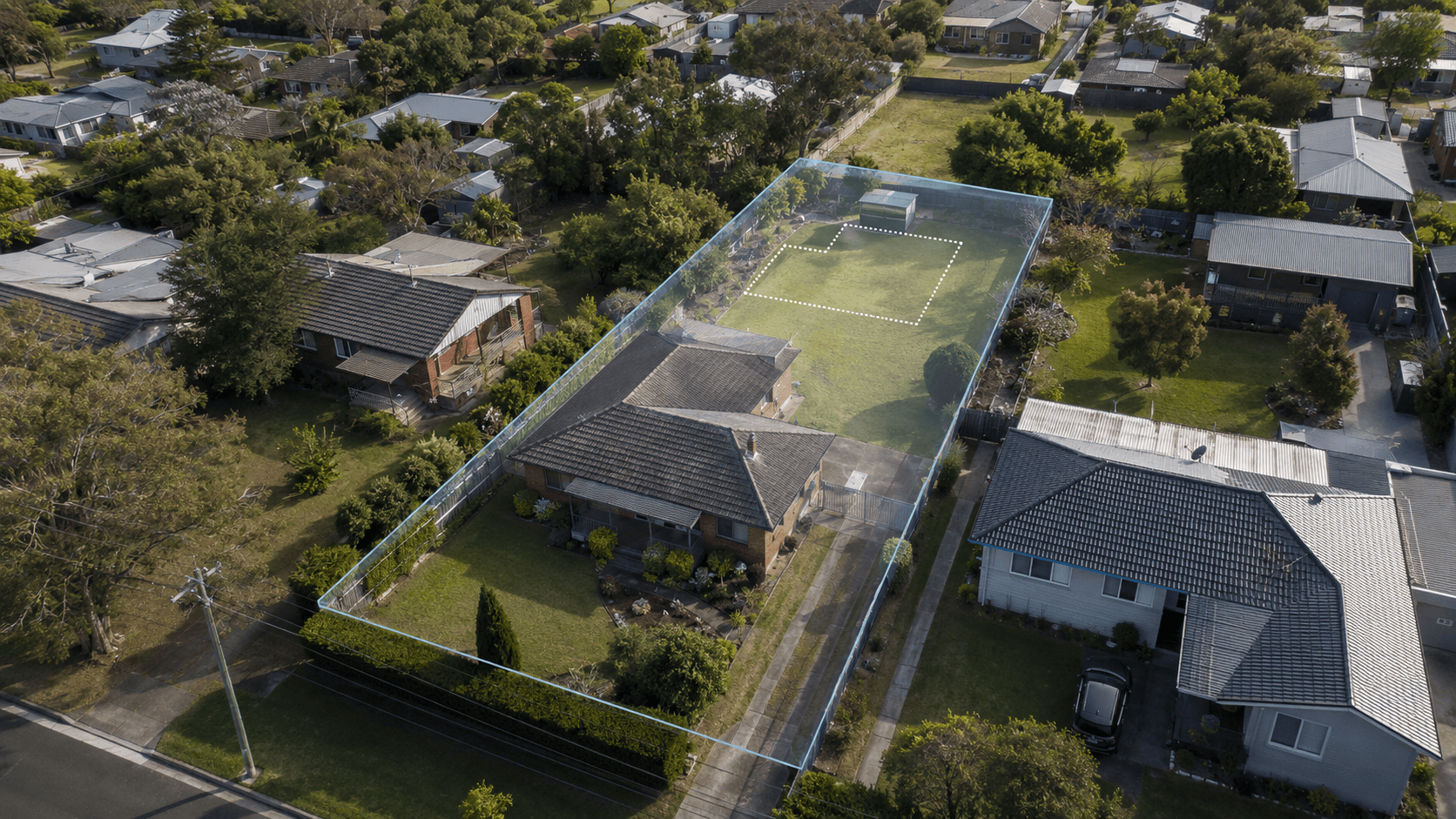
The following is a hypothetical example only, not a guaranteed outcome. Consider a Sydney homeowner planning to subdivide a large backyard and build a second dwelling to sell.
Before starting, they would typically need to check their local planning pathway, confirm whether GST applies to the new dwelling, budget for land tax while the project is under way, and get independent tax advice on whether the profit is likely to be treated as a capital gain or ordinary income. Each of these steps depends on their specific circumstances and current NSW rules at the time.
Frequently Asked Questions
- Is property development profit always taxed the same way as a normal home sale?
- No. It depends on the facts, including your intention when you bought and developed the land. Speak with a tax professional about your situation.
- Do I need council approval for every renovation?
- Not always. Some minor work is exempt development in NSW. Other projects need complying development or a full DA. Rules differ by state.
- Does GST apply if I only build one new dwelling to sell?
- It can. GST generally applies to new residential premises, though the margin scheme may reduce the amount owed. Get advice specific to your project.
- Is land tax only a concern for landlords?
- No. It is assessed annually on land value in most states, whether the land is vacant, under development, or built on, subject to state thresholds.
- Can I skip a licensed contractor if I manage my own build?
- Usually not entirely. Owner-builder rules vary by state and generally still require licensed trades for work such as electrical and plumbing.
- Does every property sale in Australia involve foreign resident withholding tax rules?
- The framework applies to all sales, but Australian residents avoid withholding by providing a clearance certificate. Check current ATO requirements before selling.
- How long is a cooling-off period after I sign a contract?
- It depends on the state and the type of contract. In NSW, it is generally five business days, extended for off-the-plan purchases. It depends on your state, so check with your own state authority.
- Will my property definitely increase in value after development?
- It depends on many factors, and no outcome is guaranteed. realCLEAR does not predict prices or market direction for any property.
- Should I get a clearance certificate even if I am an Australian resident seller?
- Yes, in most cases. Without one, the buyer may be required to withhold part of the sale price. Confirm current rules with the ATO before signing a contract.
- Is a fast-track approval pathway less strict than a full Development Application?
- Not necessarily. Fast-track pathways in NSW still require inspections during construction by a principal certifier.
Wrapping Up
Common misconceptions about property development are common because the rules are genuinely complex and differ by state. None of the fourteen points above are personal advice, and none should replace advice from a qualified professional who knows your circumstances. Our approach at realCLEAR has always been the same.
We would rather give you an honest answer than a quick sale, even when the honest answer is to wait, to hold, or to speak with an accountant first. If you are weighing up a development, a sale, or simply want a second opinion, book a free, no-obligation conversation through our Contact Us page. There is no pressure to proceed, and no cost to ask the question.
Disclaimer: This article is general information only and does not constitute financial, legal, or professional licensing advice. Requirements for real estate licensing vary by state and territory, check with the relevant fair trading or consumer affairs authority for current requirements. For advice specific to your circumstances, speak with a licensed financial adviser, registered tax agent, or solicitor.








Join The Discussion